Church Of St.Marks
Circa 2010
This website was created as part of the PR machine to promote THE LAST EXORCISM, which was released in 2010. Reverend Cotton Marcus was one of the main characters from this Eli Roth produced horror faux-documentary. In 2010, Reverend Marcus was everywhere online. He had his own blog, was on Twitter, and had this website where you could read his bio, as well as some sermon excerpts, learn a bit of history about exorcism, and even take a Demon Questionnaire to find out if you were possessed! The site was seriously hilarious.
Since the site will not be exactly as you remember it, please be indulgent.
Now let's step into Reverend John Marcus' world of demonology, possession, and exocism.
+++
We are an evangelical church with a special mission – casting Satan and his minions out of those he afflicts. For more than 75 years the Church of St. Marks has helped those most in need, and is a recognized authority on demonology and possession. We believe in the power of Jesus Christ to fight evil and banish it from humanity. Together, we can carry on his mission.
+++
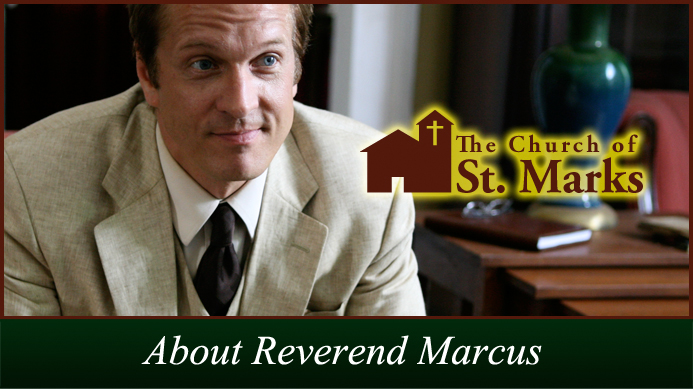
Reverend Cotton Marcus' character is a fourth generation evangelical minister and has been part of the Church of St. Marks for the past 20 years. His father, Reverend John Marcus, is also a minister and has been with the church for well over 50 years. The younger minister always appears respectable in his conservative suits and ties. His most casual attire when in public is a tieless shirt. We'll stay mum about his sartorial night choices. But he is a man with many dark secrets.
A child preacher, he began spreading the Word with his father almost from the moment he could talk. He performed his first exorcism at just ten years old. Reverend Marcus received training through the Deliverance Ministry of the Anglican Church and is a credentialed exorcist with the American Association of Exorcists.
He has cast out over 200 demons, and has been recognized by the International Society of Deliverance Ministries, the Prayer Ministries Network and the International Association of Exorcists. His wife Shanna and son Justin inspire him everyday to spread the Word and Deliver the fallen from Satan's grasp.
Join the Reverend at the Church of St. Marks this Sunday and experience worship brought to life in a powerful way.
Believe in Him.
For those struggling with possession or fear a loved one may be in the grips of a demonic force, Reverend Marcus can help.
As a medical student focused on non-traditional and integrative approaches to treating Bulimia Nervosa, I found this site deeply concerning, even when viewed in the context of its fictional origins. The way it frames complex behavioral and psychological symptoms—like self-harm, mood instability, and disordered thinking—as evidence of demonic possession risks reinforcing harmful misunderstandings about mental health. Many of the “signs” described mirror what we see clinically in eating disorders and co-occurring conditions, yet instead of encouraging evidence-based care or compassionate medical intervention, the site redirects vulnerable individuals toward fear-based interpretations and spiritual “solutions.”
What worries me most is how easily someone struggling with bulimia—who may already feel shame, secrecy, and loss of control—could internalize this narrative and delay seeking appropriate treatment. While I respect the historical and cultural context of spiritual healing practices, modern care for eating disorders requires a multidisciplinary approach grounded in psychology, nutrition, and medicine. Content like this, even as part of a viral campaign, highlights the importance of clear boundaries between storytelling and real-world health guidance. Charles Sicora
How To Avoid Demon Possession
Good people: As an ordained reverend and a sworn enemy of Satan I receive dozens of letters each month asking for my help. Asking for my guidance. Asking for succor from a hell-spawned affliction that is affecting themselves or someone they love. I am referring to possession by demonic spirits.
+++
Demons Walk Among Us
Now, not every letter is for real. Yes, there are some poor folk that have just imagined an evil spirit has possessed them as a way of avoiding some earthly problems they face. But you may be shocked to know that the vast majority of cases that come my way are real. The cold hard truth of the matter is this: demons walk among us, and they can find their way into the bodies of the innocent and force them to do unspeakable things. In 1995 I was called down to Chatom, Alabama to see if I could help a young man who had been possessed. I had to visit him in the hospital. Because he had taken a pair of wire cutters and cut off every last finger and toe on his body.
My point is: do not take this very real threat lightly.
+++

Know The Signs of Demon Possession
• Dramatic changes in personality - for example, an outgoing person become very quiet or downright mean.
• Sudden negativity towards religious objects, going to Church and/or Christianity as a whole.
• Self-mutilation (cutting, burning) or other forms of self-abuse.
• Violent acts, which very often include hurting animals.
• Speaking in a foreign language they do not know, or changes in the sound of their voice.
• Strange noises - loud knocking and banging, voices, scratching and growling may be heard with no clear source.
• The person suffers from vivid nightmares that may be violent, sexual, or convey
information they could not possibly know.
• Bruises, welts or other injuries on the body where the person could not each, possibly forming occult symbols.
+++
Understanding Evil
Now take a step back. Some of these can be signs of drug use or psychological problems. But even these issues can be the result of demonic possession. The fact is if you're seeing a majority of these symptoms, I strongly recommend taking our online application for exorcism services. Or, take our Demon Test to get a better idea of what you may be dealing with. Remember most of all not to lose hope. The prince of darkness thrives on sadness, frustration, and hopelessness – know that in me you have a friend and warrior on your side – you will not be forsaken! Believe in Him.
+++
Caring for the Afflicted
Step One: Call for help
Here's the situation: you are convinced that someone special to you has been afflicted with horror of possession. You've either talked to a pastor or read enough about it (See my article "Signs of the Devil" here) to be fairly sure. What you have experienced has you at your wits end. Someone close to you has become a living abomination, poisoned by the hand of Satan.
First, do not panic. Second – call a professional for help, like myself. DO NOT try to take this thing on all by yourself. I know of four emergency room visits, two long-term mental health facility stays and one casket – all because well meaning people thought they could go it alone. Don't do it.
Step Two: Ease the Pain
The afflicted is likely undergoing periods of extreme torment and moments of peace and lucidity. Try to make them as comfortable as possible.
• Remove all outside stresses – no calls from work, no family squabbles – keep them as calm and
quiet as you can
• Keep them in bed if possible, with the curtains down
• If they're hot, cool them with a wet rag on the forehead – If they're cold, add another blanket and
turn up the heat. It can vary depending on the demon tormenting them
• Religious objects can distress and cause physical pain to an afflicted person. Remove them
for the time being
Step Three: Remain Calm
I touched on this in the beginning of this article – but it bears repeating. DO NOT take action on your own. You may put the afflicted – or yourself – at risk.
- • Do not tie up or in any way restrain the person, unless they are truly violent
- • Do no hit, whip, or in any way abuse them
- • Do not starve or deprive them of water
- • Do not antagonize or stress the afflicted out – in some cases this can cause a violent response
Step Four: Have Faith
Most important – you've got to believe. Believe that the power of Christ will cast out the demon. Believe in your loved one who is afflicted – this isn't their fault. Forgive any trespasses they may have committed against you.
As terrifying and disturbing as a possession may be, most cases are resolved in a positive way. In the end it often means a renewal of faith in those affected, and a more joyful, connected life through Jesus Christ.
Believe in Him.
Reverend Cotton Marcus
+++
A Brief History of Exorcism
The Earliest Exorcists
The earliest accounts of exorcism date back to the dawn of civilization – in ancient Babylon, which is in present-day Iraq. Back around 2000 B.C., the Babylonian priests there attributed every last illness or mental disorder to evil spirits. And there are more early examples too:
- • The ancient Egyptians also believed sickness and other evils came from demonic possession –
- they ascribed charms and rituals to dispel them.
- • The "Artharvaveda", a Hindu sacred text from around 1000 B.C. describes many rituals for casting
- out demons and evil spirits.
- • The ancient Persians also offer accounts of exorcisms being performed as early as 1000 B.C.,
- through prayer and rituals.
The Greatest of All
But the greatest exorcist to ever live was none other than Jesus Christ. He's perhaps better known as a healer, but many of his "healings" were actually casting out an evil spirit. Interestingly, Jesus never used rituals, sacred objects, or even prayer to perform an exorcism. He simply ordered the demons to come out, and they obeyed.
- • He gave his disciples the power to perform exorcisms as well, but his skills far surpassed theirs, which should come as no surprise.
- • There are more than 25 mentions of exorcisms performed by Jesus in the bible
Later Periods
In the Middle Ages there was a renewal of belief in demonic possession and exorcism – unfortunately the techniques often were pain-based, like scourging (whipping) until the evil spirits were cast out.
In 1634, a very notable mass possession took place at a convent in Loudon, France. Seventeen nuns were overcome by dozens of different demons, which were later cast out in a public exorcism attended by thousands. Some questionwhether these were true possessions or the result of hysteria.
Exorcisms Today
Unfortunately, demonic possession's are alive and well.
• In 1974, Michael Taylor brutally murdered his wife and strangled their dog after an incomplete exorcism the night before. Police found him wandering the streets naked, covered in blood.
http://en.wikipedia.org/wiki/Michael_Taylor_(Ossett)
• In 1980, a man taunted the demons possessing his fiance's brother – the demons attacked him, possessing him instead. The eventually drove him to stab his landlord 5 times, one wound stretching from his stomach to the his heart.
http://en.wikipedia.org/wiki/Demon_Murder_Trial
• In 1993 the International Association of Exorcists was formed by Catholic priests - in 2000 it had a membership over 200 strong.
• In 1999 the Catholic Church revised its Rites of Exorcism to allow non-Latin speakers to perform them.
From the very first demonic acts in the Garden of Eden when Eve was tempted, to the modern murders and suicides caused by demonic oppression – the history of exorcism serves as a grim reminder of our never-ending battle against the forces of Satan.
Believe in Him.
Reverend Cotton Marcus
+++
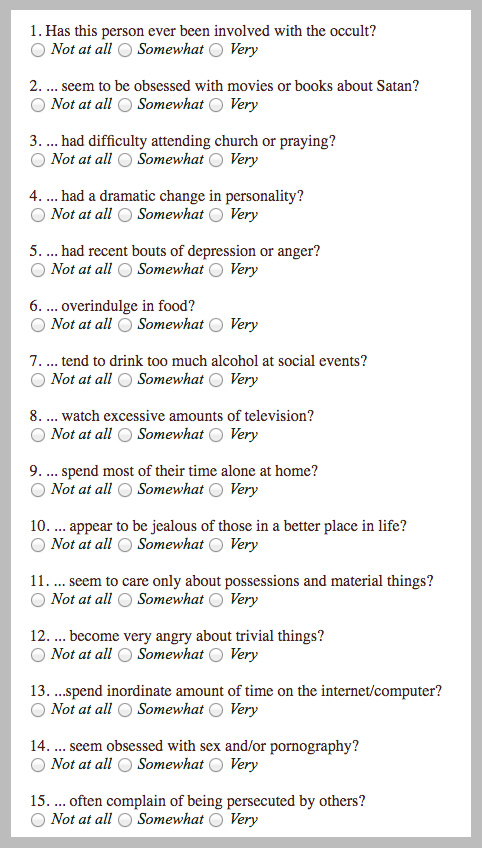
Take the Demon Questionnaire and Find Out
Is there is an evil within you or someone you care about? Do they look at you with a strangers eyes? Is there a fear in your home, an abomination around you that makes your skin crawl? Perhaps something terrible has already happened, or will soon. Do something about it. This test puts 25 years of demonology and possession into your hands. Take the questionnaire and learn which demonic force – if any – may be plaguing you or someone you love.
Believe in Him
Reverend Cotton Marcus
+++
Sermon Excerpts
November 16, 2008
"...Sometime's it's the most innocent, the most vulnerable, the ones with the best heart, that fall victim. Are they too naive? Do they let the Prince of Lies ease his way in, without knowing the danger? Until his sweaty hands are at their throat, and he's making them do things, unspeakable things..."
August 19, 2007
"...What do you people know about demons? Have you ever looked into the eyes of someone you love, and seen someone else look back? Have you ever heard someone close to you open their mouth to speak, and heard someone else's voice come out? It will make your blood turn to ice. It will make you question everything. Makes some people lose their minds..."
August 5, 2007
"...Satan is coming. For some of you, he's close. For others, he's already there. I knew a woman, lived in a nice little house with a husband and two kids. One day, out of the blue, she picked up a hatchet, put her arm on the cutting board, and took her hand off at the wrist. Her husband barely got the tourniquet on in time. When the ambulance got there she was sitting on the floor, laughing and shouting the vilest things..."
October 14, 2006
"...it's the Prince of Lies that causes you to doubt! But you let him in. You open the door to him with sin. And then he creeps into your heart, and he spreads like a cancer, and he turns the day to night, and your world into a living hell..."
More Background On ChurchOfStMarks.com
ChurchOfStMarks.com is a website that, at first glance, appears to represent a long-standing evangelical Christian institution devoted to spiritual warfare, demonology, and exorcism. Its language, structure, and tone closely resemble that of a traditional church website, complete with mission statements, pastoral biographies, sermon excerpts, and guidance for those seeking spiritual intervention. However, unlike legitimate church websites, ChurchOfStMarks.com occupies a far more unusual space at the intersection of film promotion, viral marketing, internet folklore, and horror culture.
This article provides a comprehensive overview of ChurchOfStMarks.com, exploring its origins, ownership, purpose, content, popularity, audience, and cultural significance. Rather than functioning as an actual religious organization, the website is best understood as a fictional construct designed to support a larger narrative world, while still standing as an independent artifact of early-2010s digital marketing.
Origins and Purpose of ChurchOfStMarks.com
ChurchOfStMarks.com originated as part of a viral promotional campaign created to support the release of the horror film The Last Exorcism in 2010. During this period, film studios increasingly experimented with immersive online storytelling, creating websites and digital experiences that blurred the line between fiction and reality. The goal was to extend a film’s narrative beyond the screen, encouraging audiences to interact with the story world directly.
Rather than clearly labeling the site as fictional or promotional, ChurchOfStMarks.com was intentionally presented as authentic. Visitors encountered what appeared to be the official website of a church with decades of history, a specialized ministry, and a respected leader in the field of exorcism. This approach mirrored earlier viral campaigns associated with found-footage horror films, which relied heavily on realism, ambiguity, and audience participation.
The site’s content aligned closely with the themes of The Last Exorcism, a film that follows an evangelical minister known for performing staged exorcisms who becomes entangled in events that challenge his skepticism. ChurchOfStMarks.com functioned as an extension of this narrative, giving audiences a place to explore the backstory and worldview of the fictional ministry portrayed in the film.
Ownership and Creative Control
ChurchOfStMarks.com was not owned or operated by a religious organization, nor was it affiliated with any recognized Christian denomination. Instead, the site was developed and controlled by marketing teams associated with the film’s production and distribution. While specific domain registration details from the original launch period are not easily accessible today, contemporary coverage from film marketing publications confirms that the website was deliberately constructed as a promotional tool.
The creative oversight of the campaign aligned with broader marketing strategies associated with the film’s producers, including the use of interactive web content, social media engagement, and unconventional publicity stunts. The site’s existence was time-bound to the film’s release cycle, though its continued presence online has given it a longer afterlife than many similar promotional efforts.
In later years, the domain was reportedly acquired by an individual interested in preserving or recreating elements of the original site, specifically to prevent it from being repurposed for unrelated or misleading content. This act of preservation reflects the site’s perceived cultural value among fans of horror cinema and viral marketing history.
Structure and Design of the Website
ChurchOfStMarks.com was structured to resemble a conventional church website, reinforcing its illusion of authenticity. Key design and content elements included:
-
A homepage presenting the church’s mission and spiritual focus
-
Biographical information about its lead minister
-
Educational material on demonology and possession
-
Sermon excerpts dated across multiple years
-
Interactive features designed to engage visitors directly
The layout was intentionally straightforward and understated, avoiding overt cinematic branding or promotional language. This design choice helped the site feel plausible, especially to visitors unfamiliar with the film or its marketing campaign.
The Fictional Ministry and Its Narrative World
At the heart of ChurchOfStMarks.com was a fictional evangelical ministry dedicated to combating demonic possession. The church was described as having a multi-generational history, with leadership passed down through family lines. This backstory lent an air of legitimacy and tradition, reinforcing the site’s realism.
The ministry claimed decades of experience in identifying and treating cases of possession, presenting itself as an authority on spiritual affliction. The language used throughout the site echoed that of real-world deliverance ministries, borrowing familiar theological phrasing while amplifying it to dramatic effect.
Despite its fictional nature, the site carefully avoided parody. Instead of overt humor, it adopted a serious, earnest tone that mirrored the intensity often found in religious discussions of spiritual warfare. This approach allowed the site to function simultaneously as unsettling horror content and convincing world-building.
Interactive Features and Visitor Engagement
One of the most notable aspects of ChurchOfStMarks.com was its use of interactive elements to draw visitors deeper into its narrative. Chief among these was a questionnaire designed to help users determine whether they or someone they knew might be experiencing demonic possession.
The questionnaire incorporated a series of questions framed around behavioral changes, emotional distress, and supernatural phenomena. While clearly exaggerated to horror fans, the format mimicked psychological self-assessments or spiritual diagnostics, further reinforcing the illusion of authenticity.
In addition to interactive tools, the site offered guidance on recognizing signs of possession, instructions for caring for afflicted individuals, and admonitions against attempting exorcism without professional help. These sections were written with an authoritative voice, positioning the fictional minister as both protector and guide.
Sermons and Written Content
ChurchOfStMarks.com featured a collection of sermon excerpts spanning several years, presented as archival material from church services. These sermons focused heavily on themes of evil, deception, spiritual vulnerability, and the presence of demonic forces in everyday life.
The writing style was vivid and emotionally charged, emphasizing fear, urgency, and moral struggle. By grounding the horror narrative in religious rhetoric, the site reinforced the thematic core of The Last Exorcism while offering visitors a sense of depth and continuity.
These sermons also served a practical purpose within the marketing campaign, providing shareable text that could circulate independently of the film, sparking curiosity and discussion among readers.
Popularity and Audience Reception
ChurchOfStMarks.com gained attention primarily through word-of-mouth and coverage on film and marketing blogs. Horror fans, viral marketing enthusiasts, and casual web users encountered the site through online discussions, often sharing it as an example of an unusually convincing promotional effort.
Reactions varied widely. Some visitors immediately recognized the site as fictional and appreciated its creativity and commitment to tone. Others expressed confusion or discomfort, uncertain whether the site represented a genuine religious organization. This ambiguity was a deliberate feature rather than a flaw, aligning with the found-footage genre’s emphasis on realism and uncertainty.
The site never achieved mainstream notoriety on the scale of earlier viral campaigns associated with landmark horror films, but it nonetheless earned a place in discussions of innovative digital marketing strategies.
Cultural and Social Significance
ChurchOfStMarks.com holds cultural significance as an artifact of a transitional moment in internet history. In the late 2000s and early 2010s, websites were still central to online identity and storytelling. Social media existed, but it had not yet fully supplanted standalone sites as the primary medium for immersive digital experiences.
The site also reflects broader societal fascinations with religion, fear, and the supernatural. By adopting the language and aesthetics of evangelical Christianity, it tapped into real-world anxieties and beliefs, making its fictional narrative more unsettling and compelling.
From a marketing perspective, ChurchOfStMarks.com demonstrates the power of restraint. Rather than overtly advertising a product, it created a believable environment that invited exploration and interpretation. This approach required a level of trust in the audience’s curiosity and willingness to engage with ambiguity.
What the Website Is Not
It is important to clearly state what ChurchOfStMarks.com is not:
-
It is not the official website of a real church
-
It is not affiliated with any recognized religious institution
-
It does not provide legitimate spiritual, psychological, or medical guidance
-
It was not created to solicit real congregants or donations
Understanding these distinctions is essential, particularly for readers encountering the site without prior knowledge of its fictional origins.
Preservation and Legacy
Unlike many promotional websites that disappear once a film’s marketing cycle ends, ChurchOfStMarks.com has persisted in some form due to fan interest and domain preservation efforts. This continued existence has allowed it to be studied retrospectively as an example of early viral storytelling.
Today, the site is often referenced in discussions of horror marketing, alternate reality experiences, and the ethics of realism in promotional content. While its original purpose was temporary, its afterlife as a digital curiosity has extended far beyond its initial release window.
ChurchOfStMarks.com is best understood not as a religious institution, but as a carefully constructed piece of fictional world-building designed to support a horror narrative. Through convincing design, serious tone, and interactive elements, it succeeded in blurring the boundary between fiction and reality, if only briefly.
As an artifact of its time, the site offers valuable insight into how filmmakers once used the open web as a storytelling platform. Its continued availability ensures that it remains part of the broader conversation about digital culture, viral marketing, and the evolving relationship between audiences and fictional worlds.